We've learned to find information.
What about finding people through thoughts?
Search engines find answers. Social networks help us stay in touch. But how do you meet people who are thinking about exactly the same thing right now?
Someone is looking for a startup co-founder. Someone else wants to talk about their cat's strange behavior. Another person is trying to find someone they briefly met that morning. They could live in the same city, on neighboring streets, or on opposite sides of the world—and never discover each other.
Today, starting a conversation often means first finding a group, a community, a channel, or a person. Then you have to work out whether anyone is actively discussing the subject and willing to respond.
What if people didn't have to search for the right chat? What if a conversation could emerge from a thought itself?
This idea is at the heart of the TRIGGER CHAT we are building: making the meaning behind a question, desire, or situation the starting point for human connection.
Thought. TRIGGER. Chat.
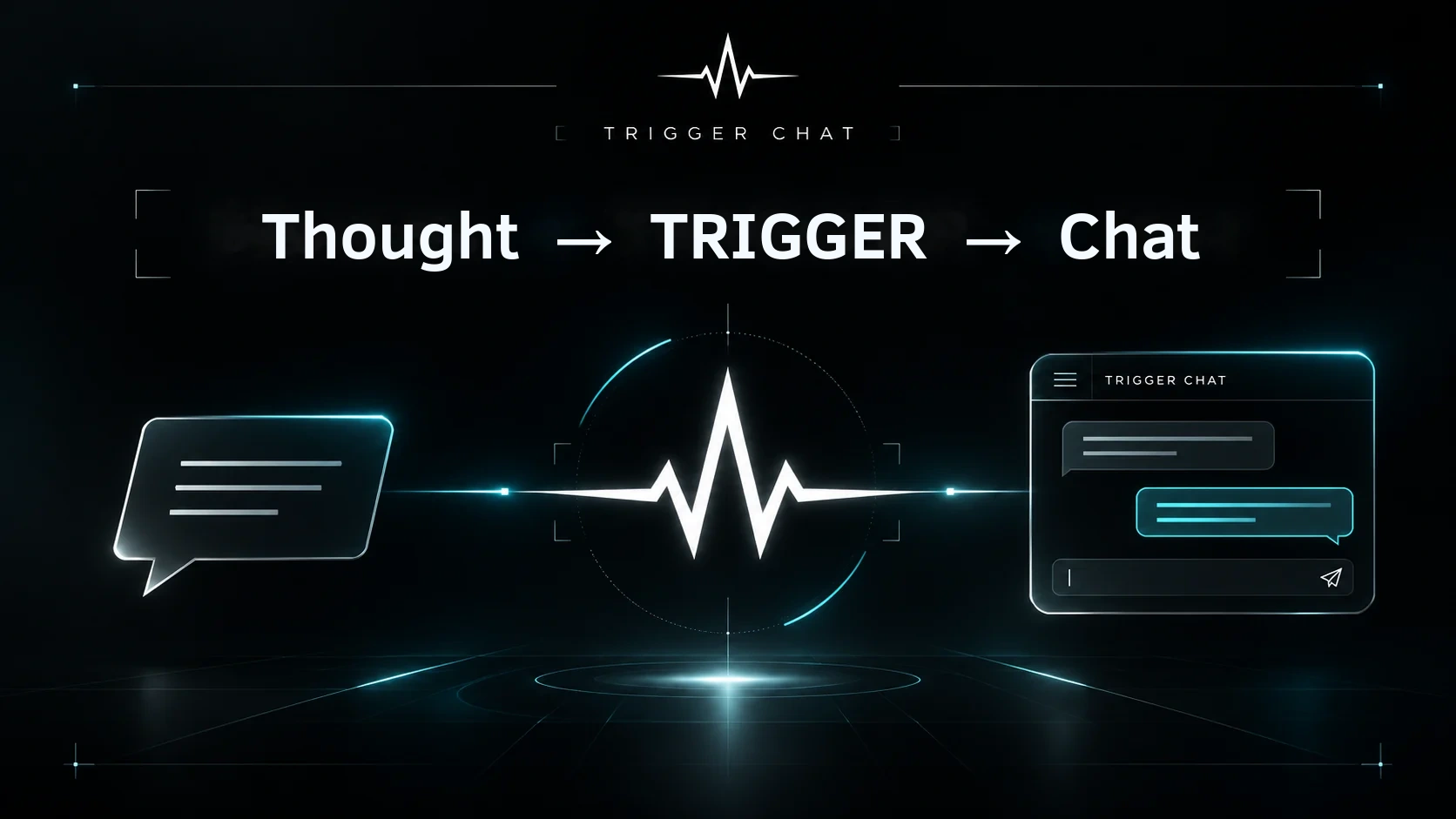
A person expresses a thought in their own words, and the Context Engine looks for people and conversations with similar or complementary meaning.
For example, one person asks, “Why do cats race around the house at three in the morning?” Another writes, “My cat goes completely wild every night at 3 a.m.” Different words, almost identical context.
The system should recognize not just the topic, but the intention. One person wants an explanation, another needs practical advice, and a third simply wants to share a funny story. They don't necessarily need the same conversation.
Choose a sample trigger:
The system could suggest a conversation with people experiencing the same thing.
Two strangers.
One bus.

A young man and a woman are riding bus 144. They've never met, but exchange glances and smiles. Neither dares to make the first move.
She gets off at her stop. The doors close. He rides on. They don't know each other's names, phone numbers, or social media accounts.
“I was on bus 144 at around 7:30 p.m. today. A girl sat opposite me. We smiled at each other, but I couldn't bring myself to say hello. Is there any way to find her?”
“I met a cute guy on bus 144 today. We kept catching each other's eye, but he never came over. I'd love to find him.”
These requests are independent and describe the event from different perspectives. Yet the route, time, circumstances, and wish to connect all match. TRIGGER could identify a potential match and invite both people to confirm that they want to connect.
If both agree, a shared chat opens. The conversation that never happened on the bus gets a second chance.
This is an illustrative scenario—not a promise that the system can identify strangers with certainty. Any match requires mutual consent; no one's identity or location is disclosed without permission.
One seller.
Three ways to ask.
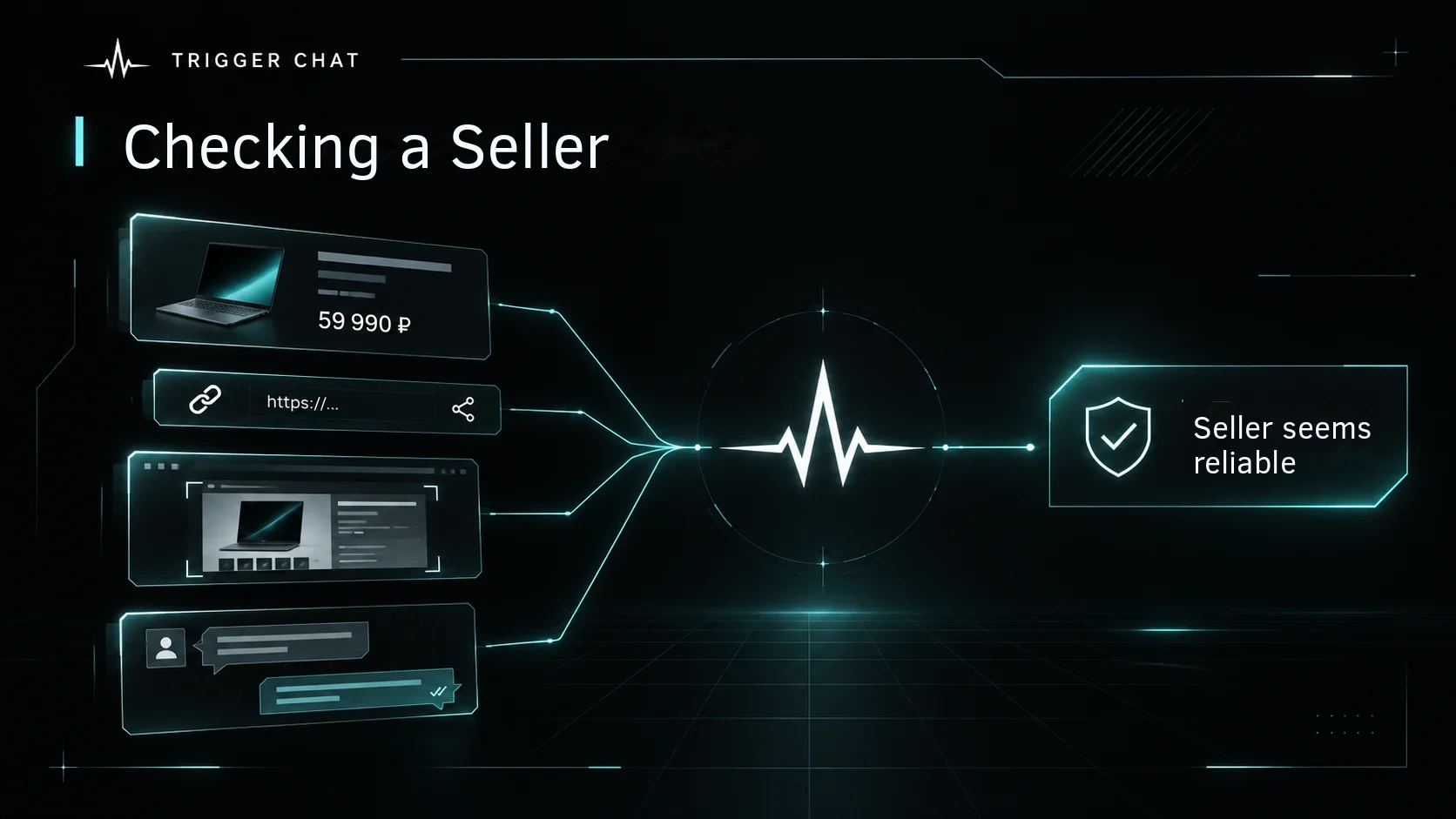
Three people are interested in the same marketplace listing. One sends a screenshot, another shares a link, and a third simply describes their concerns in their own words.
An image showing the item, price, and seller.
A listing URL shared directly from another app.
“The price looks suspiciously low. The seller wants an advance payment. Has anyone dealt with this?”
These formats differ, but the system could extract related clues: the item, listing ID, seller, transaction terms, and the user's intention to assess the risks.
If the contexts really match, TRIGGER could invite those people to discuss the situation. Someone may have spoken to the seller before, someone else might spot a red flag, and another person may share firsthand experience.
The goal is not to automatically label a person a “scammer” or “trustworthy.” It's to bring relevant context together so people can make their own decisions—while distinguishing evidence from opinions and suspicions.
The lifecycle of a trigger.
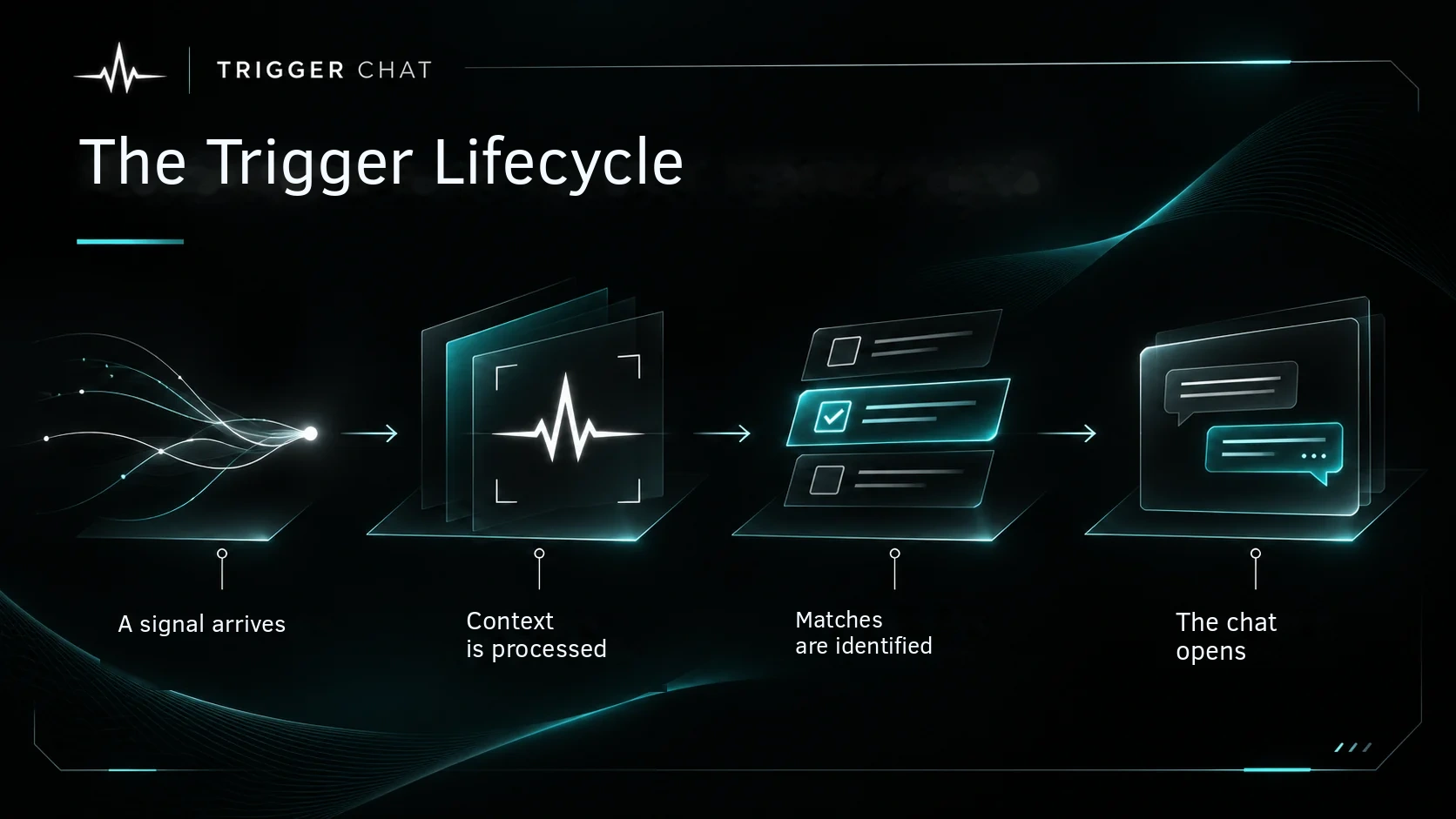
TRIGGER is more than a one-off search query. A context can remain relevant and connect with new requests later.
Identify the topic, intent, relevant entities, and conditions.
Find similar and complementary contexts, not merely identical words.
Choose a relevant chat—or wait for a better match.
People decide for themselves whether to join a suggested discussion.
If a suitable person appears later, the system can propose a new match.
The right people aren't always online at the same time. One sends a trigger today; another does so tomorrow. A persistent context can bridge that gap in time.
Trigger Me.
You don't just find context.
Context finds you.
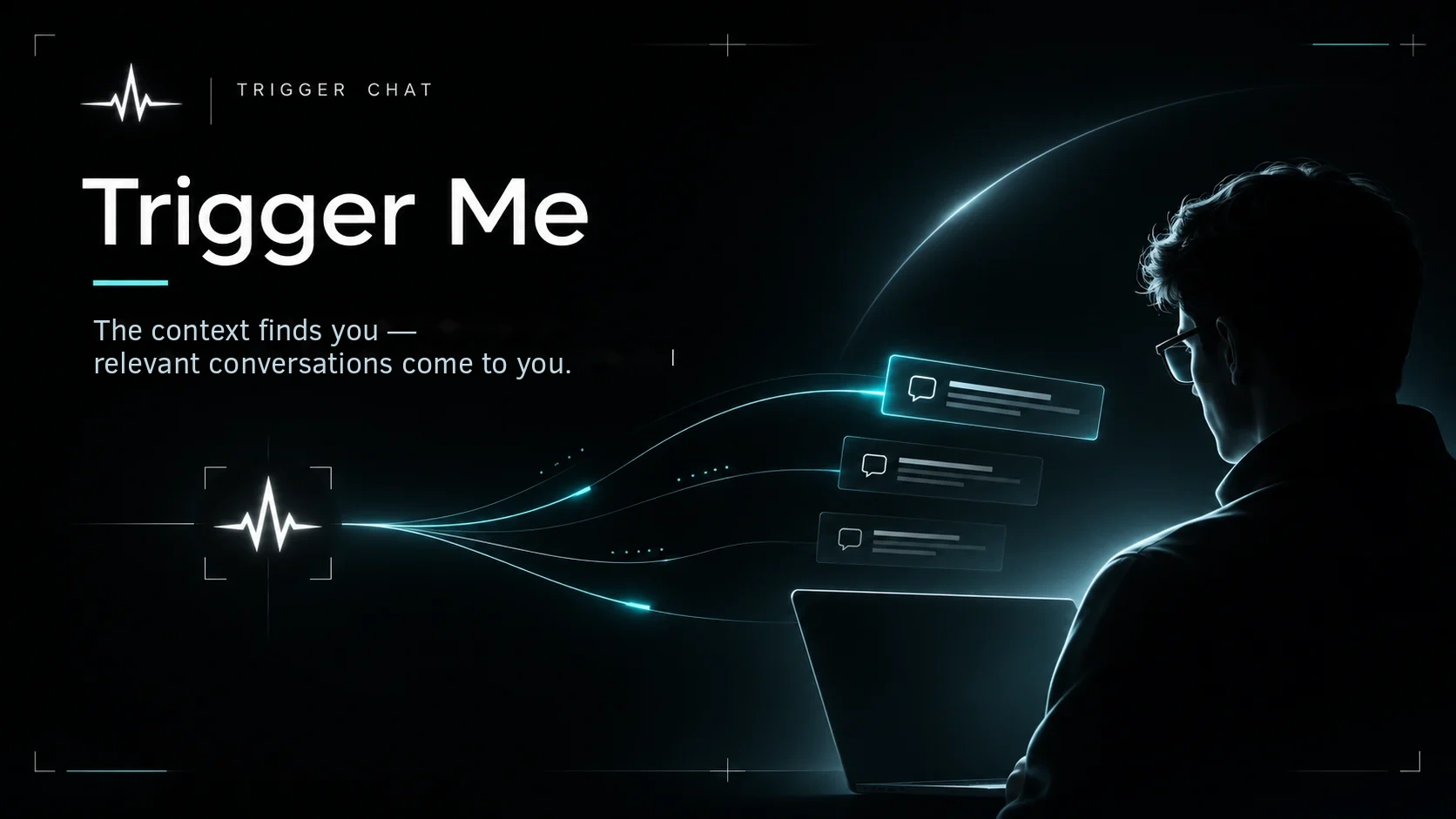
People have interests, topics, and intentions that matter beyond the moment they search. Trigger Me lets them express those interests ahead of time.
For example: “I'm interested in high-load C++ projects,” “I'd like to meet other startup founders,” “I love classic cars,” or “I'm looking for travel companions.”
When a potentially relevant context appears on TRIGGER, the system could send a notification: «Something triggered.» You can review the topic and decide for yourself whether to join.
I share a thought and actively look for a relevant conversation.
I define my interests and get notified about new matches.
No one is automatically added to a chat. People remain in control of their preferences and notifications. Instead of a feed guessing their interests from behavior, they explicitly tell the system which topics matter to them.
Contexts aren't communities.
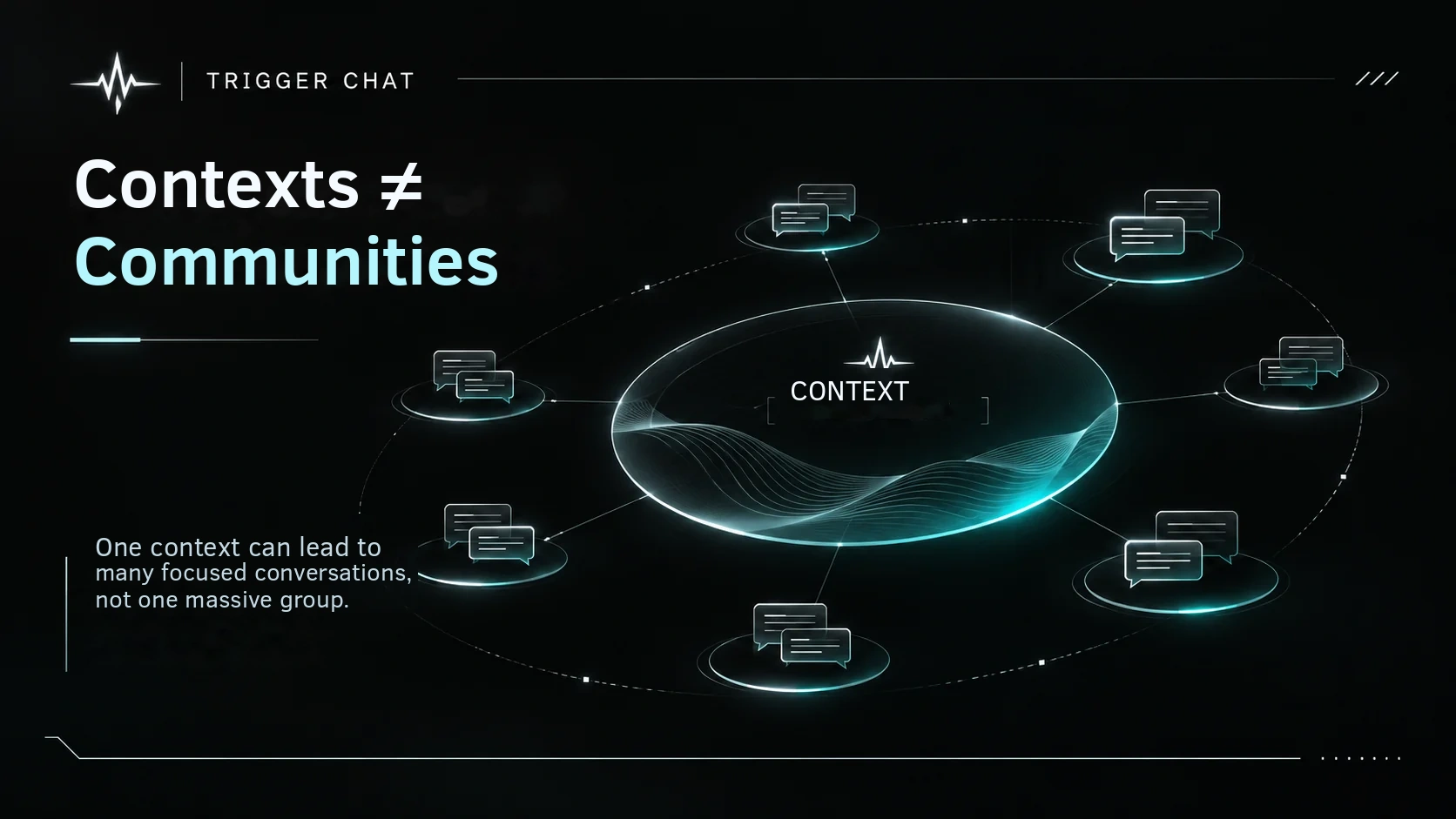
Just because ten thousand people are interested in the same question doesn't mean they all need to be placed in one enormous chat.
One person wants a quick answer, another wants an in-depth discussion, and a third hopes to meet someone specific. Even within a shared topic, the right interaction can look very different.
A context could therefore exist independently of any single chat room. Smaller conversations could form around it, each with a different purpose, group of participants, and pace.
Shared interests don't necessarily mean identical intentions. Good routing must understand why someone wants to start a conversation.
Inside the Context Engine.
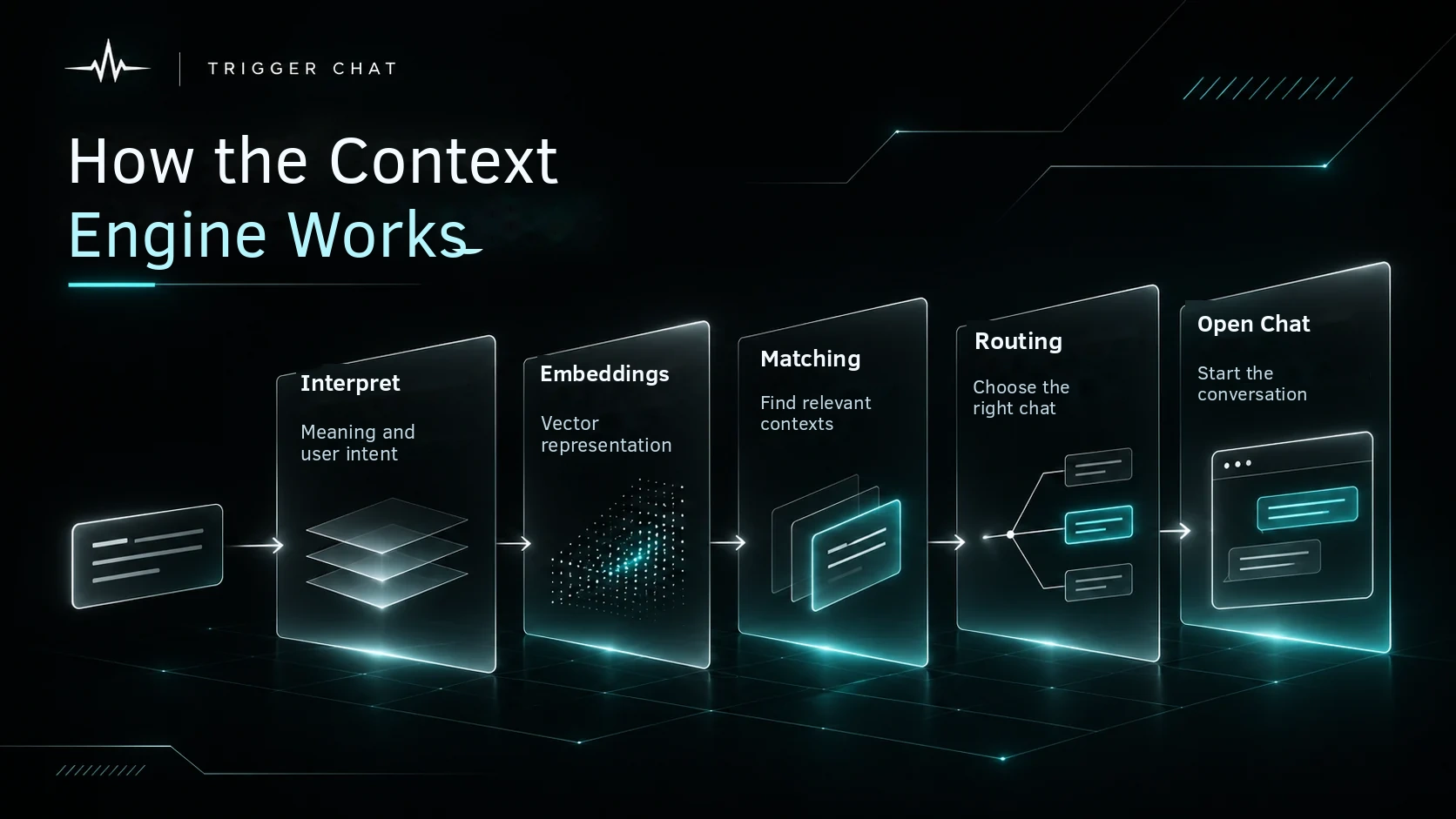
A language model alone isn't enough to build meaningful conversations between people. Understanding a request and managing human interaction are different problems.
One possible architecture separates the stages of extracting meaning, building a semantic representation, retrieving candidates, assessing the compatibility of intentions, and routing people into a relevant chat.
Embeddings can help identify semantic similarity between differently phrased messages. Images and links may require text and metadata extraction wherever technically and legally appropriate. But deciding whether contexts are compatible—and who may participate—requires a separate layer of application logic.
This diagram explains the general principle behind the Context Engine. The technical implementation will evolve as the project develops, with attention to matching quality, speed, and processing cost.
Similar topics.
Compatible intentions.
Compatibility doesn't require two people to express the same thought. Sometimes the best match is between opposite but complementary intentions.
“I want to sell a bicycle” and “I want to buy a bicycle.” “I need help with C++” and “I'm happy to mentor beginners.” These requests aren't identical, yet the people behind them could help each other.
Conversely, sharing a topic doesn't mean agreeing to argue, help, or meet. A simple cosine-similarity threshold for embeddings is not enough.
The question isn't only whether these people are talking about the same thing. It's whether they have a good reason to talk to each other.
Intentions and privacy.
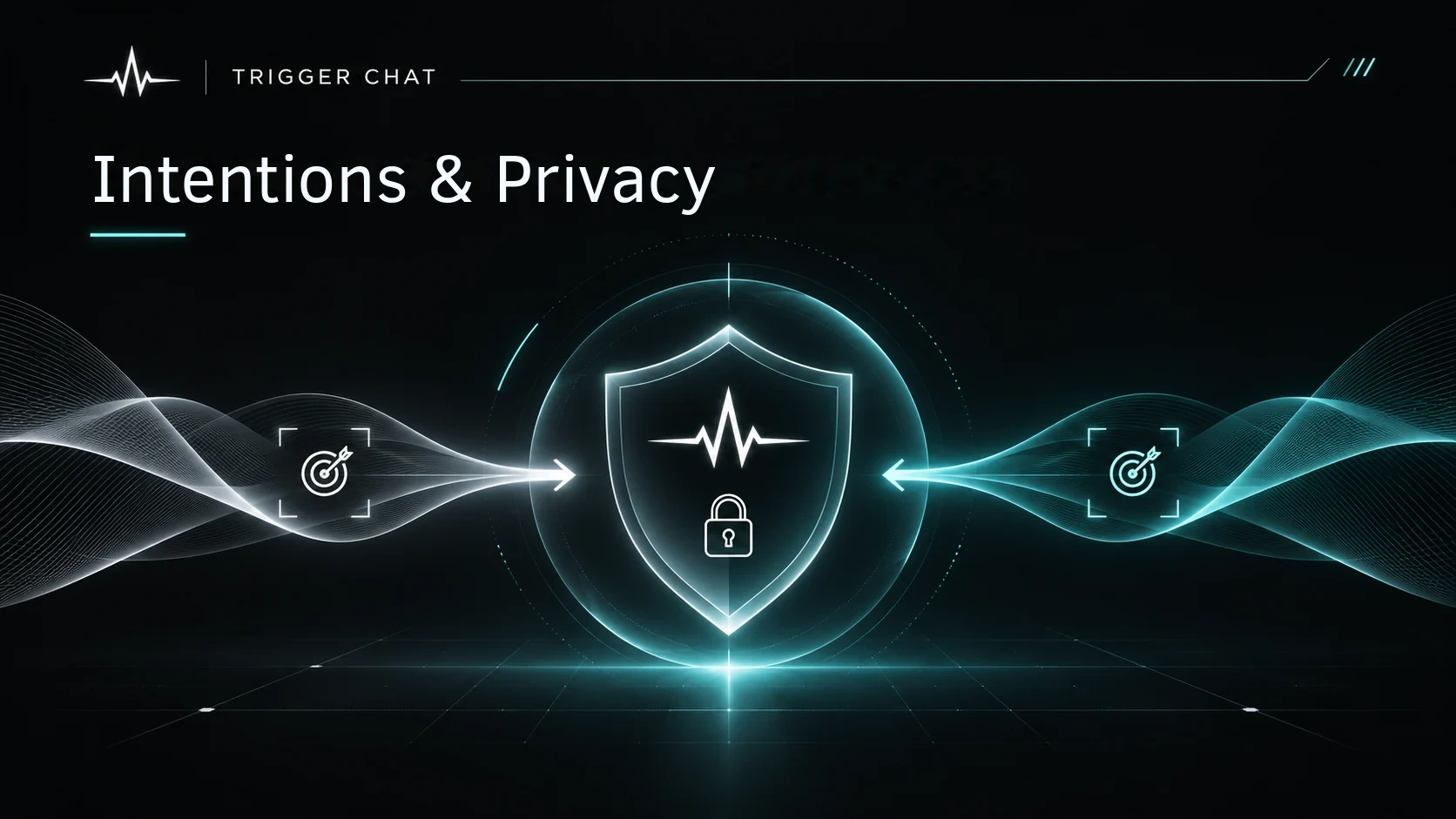
Two similar thoughts are not permission to disclose their authors' information to one another.
People may trigger sensitive subjects: health, relationships, finances, locations, or personal circumstances. Privacy therefore needs to be built into matching logic—not just the interface.
People should know what others will be able to see.
A match does not automatically place anyone in a chat.
Not everything belongs in public search results or statistics.
Protect against harassment, stalking, and unsubstantiated allegations.
This matters especially when trying to find specific people. TRIGGER should help people discover mutual interest, not identify strangers without their consent.
The use cases no one has invented yet.
Meeting people, sharing experiences, finding co-founders, shopping, building professional connections, discussing events, spontaneous encounters—all from the same underlying mechanism.
Even the word “check in” takes on a new meaning. Traditionally, it means marking your location. Now it could mean describing the context of a moment: “I'm at a conference and want to meet C++ developers,” “My flight is delayed—anyone else here?”, or “I'd like to talk about this concert.”
That kind of check-in doesn't necessarily require precise location data. It could be a check-in to a situation, an event, or an intention.
One of TRIGGER's central hypotheses is that the platform doesn't need a separate feature for every imaginable situation. It offers a universal mechanism, and people discover unexpected ways to use it.
From an idea to something real.
TRIGGER CHAT is already in development. The founder and a small team are taking the first steps toward bringing the idea to life.
This page shares the product vision and possible use cases. They describe the direction of the project; the scope and behavior of future features will evolve as work progresses.
The principle remains simple: a shared context can become the start of a conversation that people choose to join.
We are moving forward step by step, staying focused on why we are building TRIGGER: helping people find each other through thoughts.